Part III The Dream Intelligence Framework
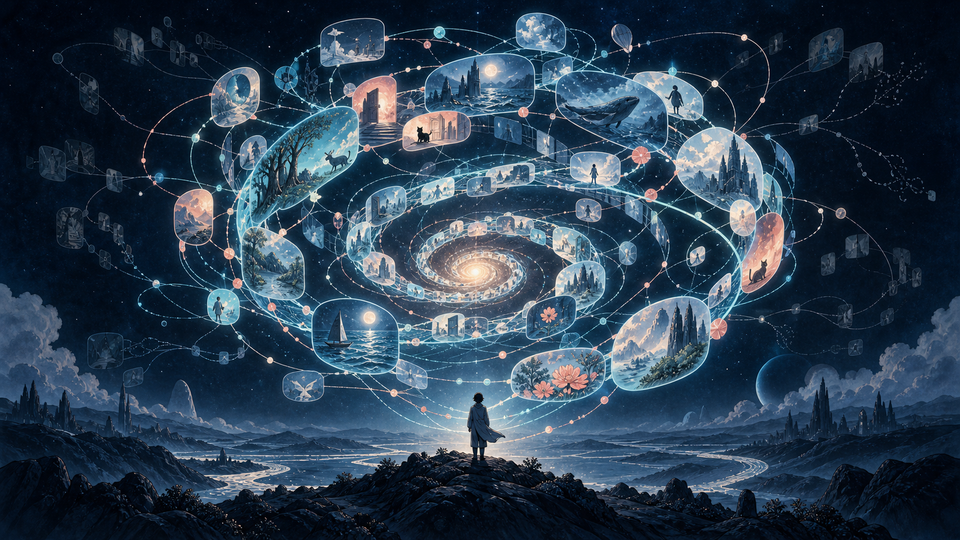
From Fleeting Dreams to Lifelong Intelligence
Dreams disappear quickly.
Within minutes of waking, much of a dream has already faded. By the end of the day, only fragments often remain. Across an entire lifetime, countless dreams are experienced, yet almost none become part of our long-term understanding of ourselves.
This raises a fundamental question.
What if dreams were not temporary experiences, but information that could accumulate into intelligence?
The Dream Intelligence Framework is an attempt to answer that question.
Rather than treating dreams as isolated stories, the framework views every dream as a multimodal cognitive signal that can be captured, structured, understood, and continuously connected with future experiences.
Its objective is simple:
Transform fleeting dream experiences into lifelong cognitive intelligence.
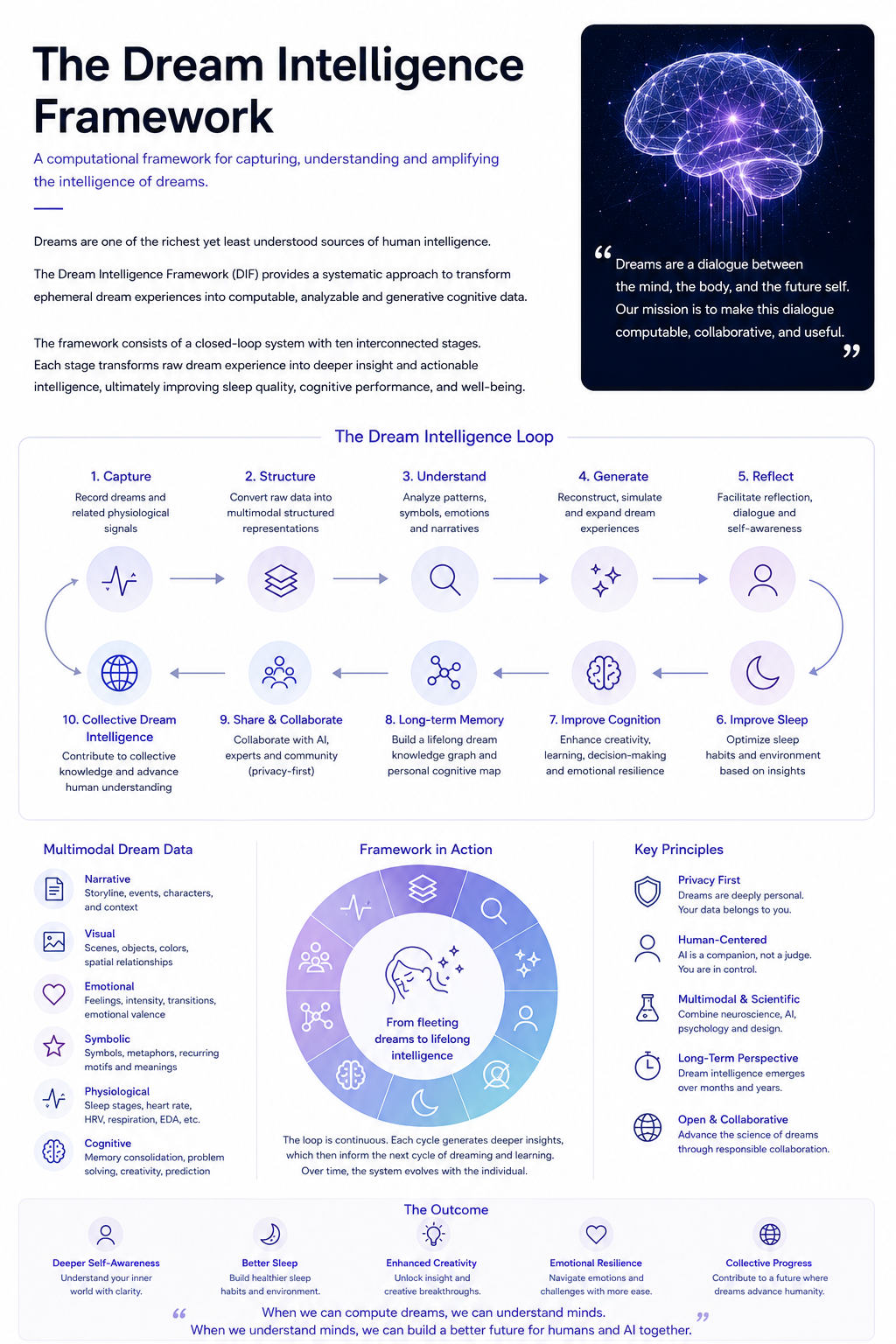
Dreams as Multimodal Data
A dream is never just a story.
Every dream simultaneously contains multiple forms of information.
- Narrative sequences
- Visual imagery
- Emotional dynamics
- Symbolic relationships
- Physiological signals
- Cognitive processes
These dimensions together form what we call Multimodal Dream Data.
Instead of interpreting only one dimension, the Dream Intelligence Framework preserves all of them simultaneously, allowing artificial intelligence to analyze dreams from multiple complementary perspectives.
This representation creates a richer and more faithful computational model of human dreaming.
The Dream Intelligence Loop
The framework is organized as a continuous learning cycle rather than a linear pipeline.
Each new dream enriches the entire system.
1. Capture
Dreams are recorded immediately after waking through text, voice, sketches, or future brain-computer interfaces.
At the same time, physiological information from wearable devices—including sleep stages, heart rate variability, respiration, and brain activity—provides objective context.
Together they preserve both subjective experience and biological state.
2. Structure
Raw memories become structured representations.
Large language models identify events, characters, locations, timelines, and semantic relationships.
Visual models organize imagery.
Knowledge representations convert dreams into machine-readable cognitive objects.
3. Understand
Artificial intelligence searches for recurring themes, symbolic structures, emotional trajectories, and behavioral patterns.
The purpose is not to assign universal meanings, but to reveal patterns that emerge uniquely within each individual.
4. Generate
Dreams become generative media.
Images, animations, cinematic scenes, interactive simulations, and future immersive environments allow users to revisit and expand dream experiences.
Generation becomes a new method of reflection rather than entertainment alone.
5. Reflect
Users engage in dialogue with their dreams.
Conversational AI helps organize thoughts, compare experiences across time, and encourage self-observation.
Reflection transforms isolated memories into personal understanding.
6. Improve Sleep
Dreams should ultimately contribute to healthier sleep.
Patterns discovered through Dream Intelligence may help individuals recognize stress, environmental influences, emotional overload, or lifestyle factors that influence dream quality and sleep architecture.
Dream analysis therefore becomes one component of long-term sleep optimization.
7. Improve Cognition
Dreams are deeply connected with creativity, memory consolidation, emotional regulation, and problem solving.
By observing dream evolution over months and years, individuals may better understand how their cognitive system changes over time.
Dream Intelligence becomes a tool for lifelong cognitive development.
8. Long-Term Memory
Every dream contributes to an evolving cognitive memory system.
Rather than storing isolated journal entries, the framework builds a personal knowledge graph connecting people, locations, symbols, emotions, and recurring experiences.
Over years, dreams become a searchable cognitive archive.
9. Share & Collaborate
Dream research advances through collaboration.
The framework allows individuals to contribute anonymized data for scientific discovery while maintaining full ownership and privacy of personal dream records.
Artificial intelligence, researchers, clinicians, and communities become collaborators rather than authorities.
10. Collective Dream Intelligence
When millions of individuals contribute structured dream data, entirely new scientific questions become possible.
How do dreams evolve across cultures?
How do global events influence collective dreaming?
Can shared symbolic structures reveal previously invisible properties of human cognition?
Dream Intelligence ultimately extends beyond personal insight toward a collaborative understanding of the human mind.
Design Principles
The Dream Intelligence Framework is built upon five guiding principles.
Privacy First
Dreams represent one of the most personal forms of human data. Users retain ownership and control of every record.
Human-Centered AI
Artificial intelligence assists reflection rather than replacing human interpretation.
Multimodal Intelligence
Dreams should be understood through language, vision, physiology, and cognition simultaneously.
Long-Term Perspective
The value of dreams emerges across months and years, not through isolated interpretations.
Open Scientific Collaboration
The framework is designed to encourage interdisciplinary research across neuroscience, psychology, artificial intelligence, sleep science, philosophy, and design.
Beyond Dream Journals
Traditional dream journals preserve memories.
The Dream Intelligence Framework builds intelligence.
Instead of asking:
What did I dream last night?
It asks:
What have my dreams been teaching me over the past ten years?
This shift transforms dreaming from an ephemeral experience into a continuously evolving cognitive system.
Dreams become not only memories of the night, but a lifelong source of insight into creativity, emotion, learning, and human intelligence itself.
Member discussion