Part I Manifesto

Building Dream Intelligence
For centuries, dreams have been treated as something mysterious, irrational, or impossible to study.
They disappear within minutes after waking. They resist language. They cannot be replayed, measured, or searched like ordinary memories.
Yet every night, billions of people generate an astonishing amount of cognitive activity.
Dreams may represent one of the largest unexplored datasets of human experience.
I believe this will change.
Artificial intelligence is rapidly transforming how we understand language, images, biology, and software. The next frontier is not only making machines more intelligent, but developing better ways to understand human intelligence itself.
Dreams are one of the missing pieces.
They contain emotion without censorship, memory without deliberate control, imagination unconstrained by physical reality, and patterns that often remain invisible during waking life.
Rather than treating dreams as isolated stories, I see them as structured cognitive signals that can be recorded, modeled, analyzed, and eventually computed.
This is what I call Dream Intelligence.
Dream Intelligence is the emerging discipline of representing dreams as structured information that can be understood collaboratively by humans and AI.
It combines neuroscience, sleep science, artificial intelligence, computational cognition, psychology, design, and creative technology into a shared computational framework.
The goal is not to explain every dream.
The goal is to build better tools for observing, organizing, and understanding one of the most overlooked dimensions of human cognition.
This vision extends beyond dream journals or AI-generated images.
I imagine a future where dreams become part of a broader personal intelligence system.
Wearable devices continuously measure sleep physiology.
Large language models help organize dream narratives.
Multimodal models reconstruct visual experiences.
Long-term memory systems discover recurring emotional and symbolic patterns across years.
Instead of isolated entries, dreams become longitudinal cognitive data.
Understanding dreams may ultimately improve creativity, emotional awareness, mental health, scientific research, and even the development of more human-centered artificial intelligence.
To explore this possibility, I founded NeuroDream.
NeuroDream is building the infrastructure for Dream Intelligence.
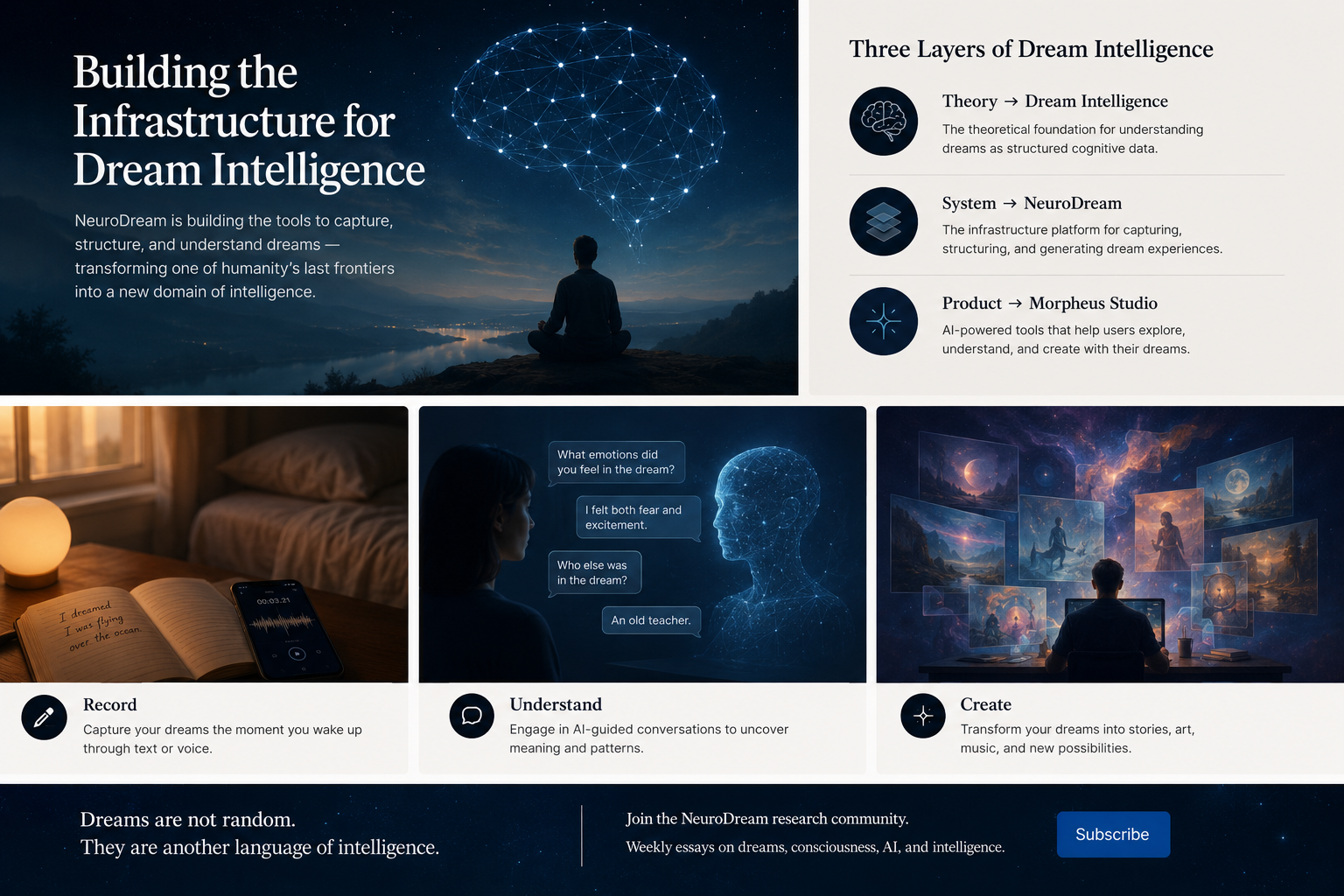
It is an ongoing effort to create the tools, research framework, and computational systems needed to record, structure, model, and generate dream experiences.
This website serves as my public research notebook.
Here I share essays, experiments, product development, reading notes, and ideas that contribute to this long-term mission.
Much of what appears here will evolve over time.
Some ideas will prove wrong.
Others may become foundations for future research.
The purpose is to think openly, build publicly, and invite collaboration.
If you are interested in dreams, consciousness, neuroscience, artificial intelligence, computational cognition, or the future of human intelligence, I hope you'll find something worth exploring here.
We're only beginning to understand what dreams are.
Perhaps we're also beginning to understand what intelligence can become.
—
Yanni Chen
Founder, NeuroDream
Member discussion