About Yanni Chen
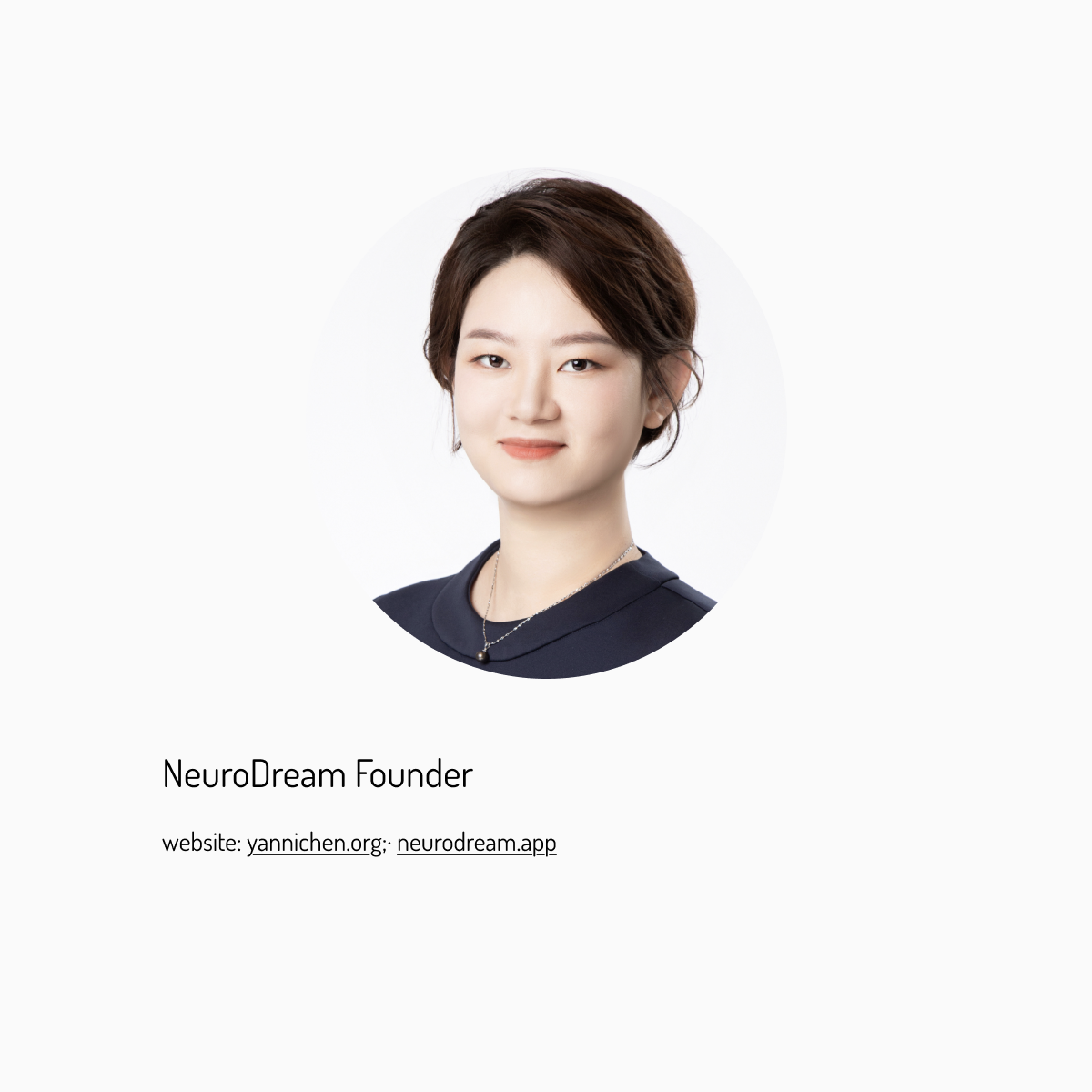
I'm Yanni Chen.
I'm building the computational infrastructure for dreams.
I believe dreams are one of the last unexplored frontiers of human intelligence. Every night, billions of people generate rich cognitive experiences that vanish within minutes of waking. For most of human history, they have remained private, fleeting, and computationally invisible.
I don't think that has to remain true.
Recent advances in artificial intelligence, neuroscience, wearable sensing, and large-scale personal data make it possible to approach dreams in an entirely new way—not as mystical symbols to decode, but as structured cognitive phenomena that can be recorded, modeled, and studied over time.
That is the work I have chosen to dedicate my life to.
How it started
I've recorded my dreams continuously for the past twenty-four years.
What began as a simple habit gradually became a long-term archive of my own mind—thousands of dream fragments, recurring symbols, emotional patterns, and questions that no existing tool could help me understand.
As a teenager, I published a poetry collection based entirely on dreams. Years later, I entered the AI industry, where I witnessed firsthand how computational systems could reshape entire industries.
Those two paths—dreams and AI—seemed unrelated for many years.
Eventually I realized they had always been leading toward the same question:
Can dreams become computable?
That question became the foundation of everything I am building today.
Not as a product idea, but as a new layer of understanding:
Building the infrastructure for dream intelligence.
Exploring the intersection of AI and human cognition.
What I'm building
My work is organized into three connected layers.
Dream Intelligence
A computational framework for understanding dreams as structured cognitive data rather than symbolic puzzles.
Instead of asking "What does this dream mean?", Dream Intelligence asks a different question:
What patterns emerge across hundreds of dreams over months and years?
Meaning is treated as something that emerges from longitudinal observation, personal context, and computational analysis—not from universal symbol dictionaries.
NeuroDream
The infrastructure layer.
NeuroDream transforms nightly dream experiences into private, structured, longitudinal cognitive data while preserving uncertainty, individual context, and user ownership.
It is designed as foundational infrastructure for future research, AI applications, and personal cognitive tools.
Morpheus Studio
The first application built on NeuroDream.
Morpheus Studio is a Dream OS where people can capture dreams immediately after waking, organize years of dream history, converse with their archive, visualize recurring themes, generate creative work, and observe how their inner world evolves over time.
It does not tell people what their dreams mean.
It helps them discover how meaning gradually emerges from their own lives.
Why now
Dream research has existed for more than a century, yet many fundamental questions remain unanswered.
Rather than waiting for neuroscience to fully explain dreaming, I believe we can begin building useful computational systems today.
For the first time, several technologies are converging:
- AI capable of modeling complex language and personal data
- wearable devices measuring sleep continuously
- multimodal interfaces for recording experiences naturally
- long-term personal data that can reveal cognitive patterns impossible to observe in isolated dreams
Together, they create an opportunity that simply did not exist before.
Long-term vision
My long-term goal is to make dreams a first-class object of computation.
I believe dreams should become observable, searchable, modelable, and computationally meaningful—while remaining deeply personal and fully owned by the people who experience them.
In the future, dream data may contribute to cognitive science, creativity, mental well-being, personalized AI, and our broader understanding of human intelligence.
Whether that future arrives in five years or twenty, I intend to spend my career helping build it.
Collaboration
I'm always interested in conversations with researchers, neuroscientists, sleep scientists, AI engineers, designers, founders, universities, healthcare organizations, and others exploring the future of human cognition.
If our work overlaps, I'd be happy to connect.
The fastest way to reach me is:
Every night we generate experiences that disappear before breakfast.
I don't believe they should disappear.
I believe dreams deserve memory.
They deserve structure.
They deserve computation.
And I believe understanding dreams may become one of the next great frontiers of intelligence.
Continue exploring
- The framework → Dream Intelligence
- The flagship essay → Dream Intelligence: the essay
- The infrastructure → NeuroDream
- The product → Morpheus Studio
- More writing → Essays · Research